Who Is the Biggest Muslim Influencer? And Why Brands Are Asking the Wrong Question
Learn why follower count is not enough and how brands can choose trusted Muslim creators with real engagement, niche relevance and audience trust.
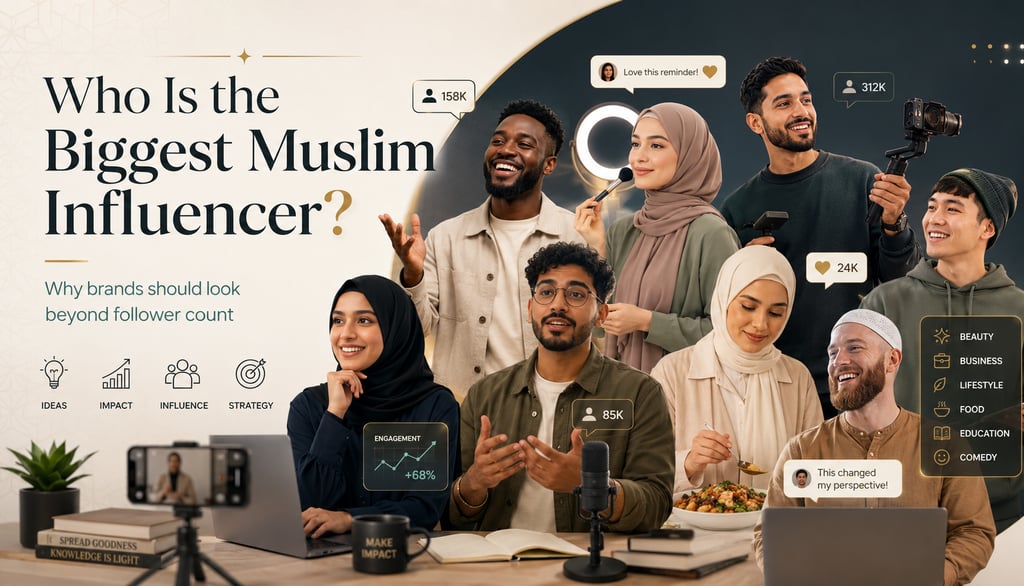
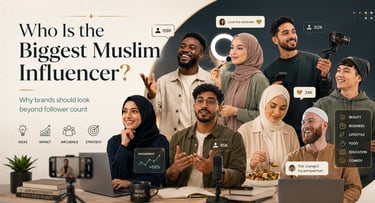
Who Is the Biggest Muslim Influencer? And Why Brands Are Asking the Wrong Question
When people ask, “who is the biggest Muslim influencer?”, they usually mean one thing:
Who has the most followers?
And if we are talking purely about follower count, one of the most obvious names is Khaby Lame. He is widely recognised as one of the most-followed creators in the world, with a huge global audience across TikTok, Instagram and other platforms. He has also publicly spoken about being Muslim, which makes him one of the biggest Muslim creators online by audience size.
But here is where brands need to slow down a little.
The biggest Muslim influencer is not always the best Muslim influencer for your campaign.
That might sound obvious, but in influencer marketing, follower count has a way of making sensible people suddenly forget how strategy works. Big numbers look impressive. They feel safe. They make a campaign proposal look shiny.
But big does not always mean relevant, trusted or commercially useful.
And when it comes to reaching Muslim audiences, relevance matters.
What Counts as a Muslim Influencer?
A Muslim influencer is not only someone who creates Islamic reminders or religious content.
Muslim creators exist across every niche you can think of: beauty, modest fashion, parenting, food, comedy, fitness, education, business, sport, lifestyle, travel and more.
A Muslim influencer may be someone who is openly Muslim, visibly Muslim, values-led, or simply known by their audience as a Muslim creator. Their content does not have to be religious for their Muslim identity to matter.
That distinction is important.
For example, Khaby Lame is known globally for silent comedy, not Islamic content. Huda Kattan is known for beauty and entrepreneurship. Ali Abdaal is known for productivity, education and business. Khalid Al Ameri is known for lifestyle, culture and family-centred content.
They are not all doing the same thing.
They are not speaking to the same audience.
And that is exactly the point.
Biggest by Followers Does Not Mean Best for Your Brand
If a brand is selling halal snacks in the UK, would the “biggest” Muslim influencer in the world automatically be the best choice?
Not necessarily.
A smaller UK-based Muslim food creator with 20,000 loyal followers may have more impact than a global lifestyle creator with millions of passive followers. Why? Because their audience is more specific, more relevant and more likely to trust their recommendations.
Influence is not just about how many people see the content.
It is about whether the right people care enough to act.
That action might be clicking, buying, signing up, sharing, commenting or simply trusting the brand more after seeing the campaign.
A big follower count can open doors. But genuine trust is what moves people through them.
If you are a brand trying to reach Muslim consumers through Muslim influencers, the real question is not simply who has the biggest following. The real question is which creator has the right audience, the right trust and the right values for your campaign.
Red Flags When Choosing a Muslim Influencer
Brands should be careful of:
Fake or inflated followers.
Generic content with no real voice.
Weak engagement.
Comments that feel empty or automated.
Constant brand deals with no selectivity.
Creators who promote anything and everything.
Poor understanding of Muslim sensitivities.
Audience mismatch.
A lack of clear values or boundaries.
One of the biggest red flags is when every other video is a brand deal.
Audiences notice.
Muslim audiences especially notice, because trust and integrity sit at the centre of influence. If a creator appears to have no boundaries, the audience may start to question every recommendation they make.
So, Who Is the Biggest Muslim Influencer?
If we are talking about follower count, Khaby Lame is one of the clearest answers. He is one of the most-followed creators in the world and has a huge global audience.
But if you are a brand, that should not be the end of the conversation.
The better question is:
Who is the biggest Muslim influencer for your audience, your niche and your campaign goal?
Because the best creator for a halal food brand may not be the best creator for a modest fashion brand.
The best creator for a UK Muslim parenting campaign may not be the best creator for a global beauty launch.
The best creator for a Ramadan campaign may not be the person with the biggest following, but the person with the deepest trust.
There are different types of “biggest”.
The biggest Muslim beauty influencer.
The biggest Muslim business creator.
The biggest Muslim comedy creator.
The biggest Muslim fitness influencer.
The biggest Muslim parenting creator.
The biggest Muslim food reviewer.
The biggest Muslim lifestyle voice.
And within each category, there will be creators with different strengths, audiences, values and cultural reach.
A Personal Note From The Muslim Reach
As a revert Muslim with a background in Music, Entertainment & Arts Management, I see Muslim influencer marketing from both sides.
I understand what brands are trying to achieve commercially.
But I also understand what Muslim audiences need to see before they trust a campaign.
That matters.
Because reaching Muslim consumers is not about ticking a diversity box, finding someone in a hijab, or remembering Muslims once a year during Ramadan.
It is about respect, relevance and strategy.
The Muslim influencer with the biggest following is not always the right choice for your brand.
A truly influential Muslim creator is someone who is not ashamed of their Islam, lays boundaries firmly regarding it, understands their audience and has built genuine trust.
That is the kind of influence brands should be looking for.
Not just reach.
Real connection.
The Muslim Influencer Your Brand Actually Needs
This is why Muslim influencer marketing needs more than a quick follower-count search. Brands need creators who understand their audience, respect Muslim values and can represent campaigns with sincerity.
At The Muslim Reach, the focus is not just on numbers. It is about helping brands find Muslim creators who align with their audience, values and campaign goals.
For creators, this matters too. If you are building a loyal audience and want to work with aligned brands without compromising your values, your influence is not only measured by numbers. It is measured by trust, consistency and the relationship you have built with your community.
Because the biggest Muslim influencer is not always the one with the most followers.
It is the one who can move the right Muslim audience to trust, click, buy or act.


The Biggest Mistake Brands Make With Muslim Influencers
The biggest mistake brands make when looking for Muslim influencers is that they go for the safe option.
They look for the creator who feels familiar, polished and easy to understand. They often choose the same narrow type of Muslim representation again and again.
And let’s be honest, this is where the industry needs a head wobble.
Muslims are not one big identical audience.
We are Black, Asian, Arab, white, East Asian, mixed heritage, reverts, born Muslims, practising in different ways, living across different cultures and shaped by different communities.
Even modesty is not expressed in one single way across the Muslim world. What looks modest in one Muslim culture may look completely different in another.
So when brands treat “Muslim influencer marketing” as if it only means one ethnicity, one aesthetic or one type of creator, they miss huge parts of the Muslim market.
Asian, Arab and white revert creators are often more visible in mainstream Muslim creator spaces. But Black Muslims, East Asian Muslims and other underrepresented Muslim communities are still too often overlooked.
That is not just a representation issue.
It is a strategy issue.
Muslim Audiences Are Not a Tiny Niche
Muslims make up around a quarter of the world’s population. That means Muslim consumers are not some tiny niche sitting quietly in the corner waiting for a Ramadan advert with a lantern graphic.
Muslim audiences are global.
Diverse.
Digitally active.
Brand-aware.
And very capable of spotting when a campaign has been thrown together five minutes before Eid.
A “Ramadan Mubarak” caption is not a strategy.
A crescent moon slapped onto a graphic is not cultural understanding.
And tokenism? Muslim audiences can smell it from three scrolls away.
If brands want to reach Muslim consumers properly, they need to understand the audience, choose creators carefully and respect faith-based boundaries.
What Brands Should Look For Instead of Follower Count
Follower count is useful, but it should never be the whole decision.
When choosing a Muslim influencer, brands should look at:
Engagement. Are people actually responding, asking questions and having conversations? Or is the comment section just a graveyard of fire emojis?
Audience alignment. Does the creator’s audience match the people the brand wants to reach?
Niche relevance. A Muslim fitness creator, modest fashion creator, halal food reviewer and Muslim parenting creator are not interchangeable.
Trust. Does the audience believe this creator? Do they listen when they recommend something?
Comment quality. Real influence is often visible in the comments. Look for genuine questions, thoughtful replies and people defending or supporting the creator.
Values and boundaries. For Muslim audiences, this matters deeply. A creator’s integrity is part of their influence.
For brands that want to work with trusted Muslim creators, this is where strategy matters. A creator may have a smaller audience, but if that audience is active, loyal and aligned with your product, they can often create far more impact than a huge influencer with passive followers.
This is especially important when brand ethics are involved.
For many Muslim consumers, issues such as Palestine, halal standards, modesty, family values and faith-based boundaries are not small details. They can affect whether a campaign is trusted or rejected.
A Muslim creator who will promote anything for money is not necessarily an asset.
Sometimes, they are a walking brand risk in nice lighting.